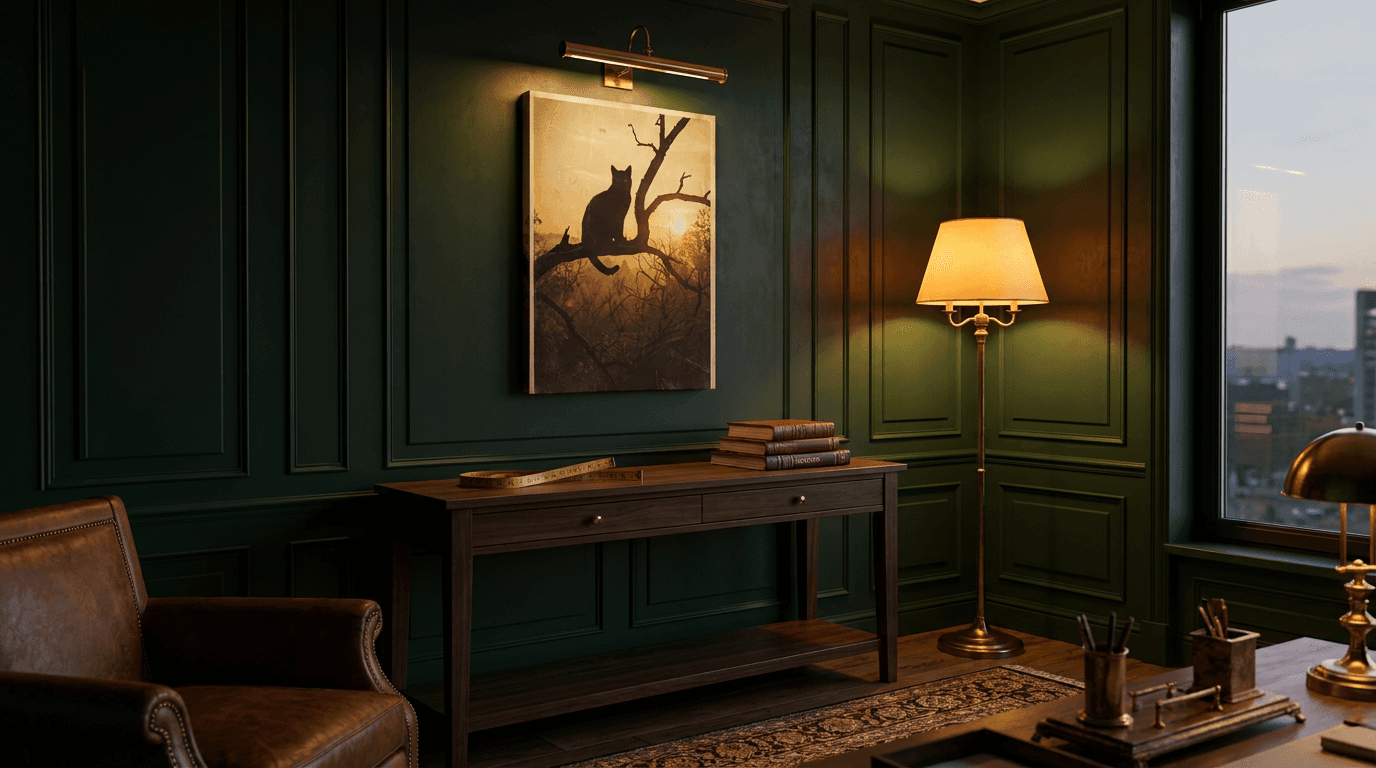
Above sofa wall decor: how to size, hang and style art over your couch
How wide, how high, and which layout: the sofa wall solved with pairs, trios and grids of portrait prints, with the arithmetic for every sofa width.
The wall above the sofa is the biggest, most-looked-at stretch of empty space in most living rooms, and it is where the most common decorating mistake happens: one small picture, hung too high, floating in the middle of two metres of nothing. The fix is not a bigger budget. It is two numbers and a layout.
This guide gives you both: the sizing rule and how to apply it to your own sofa, the hanging height, then seven above sofa wall decor layouts built from portrait-format prints, with the exact width each one covers. Style and colour come last, because once the proportions are right, almost any artwork you love looks intentional.
How big should wall decor above a sofa be?
Art above a sofa should span two-thirds to three-quarters of the sofa's width. Measure the sofa from arm to arm, multiply by 0.67 and 0.75, and the result is the total width your artwork, or your group of artworks, should cover. For a 200 cm three-seater that is roughly 133 to 150 cm of art.
Measure the sofa, not the wall. The eye reads the sofa and the art above it as one block, so the art is sized to the sofa even when the wall runs much wider. A print covering half the sofa or less looks like it was hung before the sofa arrived; one that overhangs the arms looks top-heavy.
The 2/3 rule, with the arithmetic
The rule works on the total width of the composition, gaps included, so you juggle three figures: the width of each print, the number of prints, and the gap between them. Keep gaps between 5 and 8 cm. Wider and the eye stops reading the pieces as a group; tighter and frames start to crowd each other.
Total width = (print width × number of prints) + (gap × number of gaps). Two 60 cm wide prints with an 8 cm gap give 60 + 8 + 60 = 128 cm, almost exactly two-thirds of a 190 to 200 cm sofa. Our wall art size guide has the chart for every room; the table below is the sofa-specific version.
Why vertical prints fill a wide wall better than one wide canvas
Most advice on the sofa wall ends with "buy one oversized horizontal canvas". It works, but a single 130 cm wide piece is expensive, awkward to move, and locks the wall to one image forever. Portrait-format prints solve the same width problem more flexibly.
Two or three vertical prints side by side cover the same span, but each piece can be swapped or taken to the next flat. Their repeated vertical edges add rhythm above a long, low sofa, exactly the contrast a living room needs. And because the large formats (50×75 and 60×90 cm, the latter printed at 61×91 cm) are tall, the group has real presence without being enormous.
Target widths for common sofa sizes
| Sofa width | Art width (2/3 to 3/4) | Composition that fits |
|---|---|---|
| 160 cm loveseat | 107 to 120 cm | Two 50×75 cm prints, 7 to 8 cm gap = 107 to 108 cm |
| 180 cm | 120 to 135 cm | Two 60×90 cm prints, 6 cm gap = 126 cm |
| 200 cm | 133 to 150 cm | Two 60×90 cm prints, 8 cm gap = 128 cm, or a 4×2 grid of 30×45 cm = 138 cm |
| 220 cm | 147 to 165 cm | Three 50×75 cm prints, 5 cm gaps = 160 cm |
| 240 cm | 160 to 180 cm | Three 50×75 cm prints, 6 cm gaps = 162 cm |
| 280 cm sectional | 187 to 210 cm | Three 60×90 cm prints, 6 cm gaps = 192 cm |
A pair of 60×90 cm prints above a 180 to 200 cm sofa is the combination that works most often, which is why it leads the layouts below. If your sofa falls between two rows, round up: slightly generous art always reads better than slightly mean art.
How high to hang art above a sofa
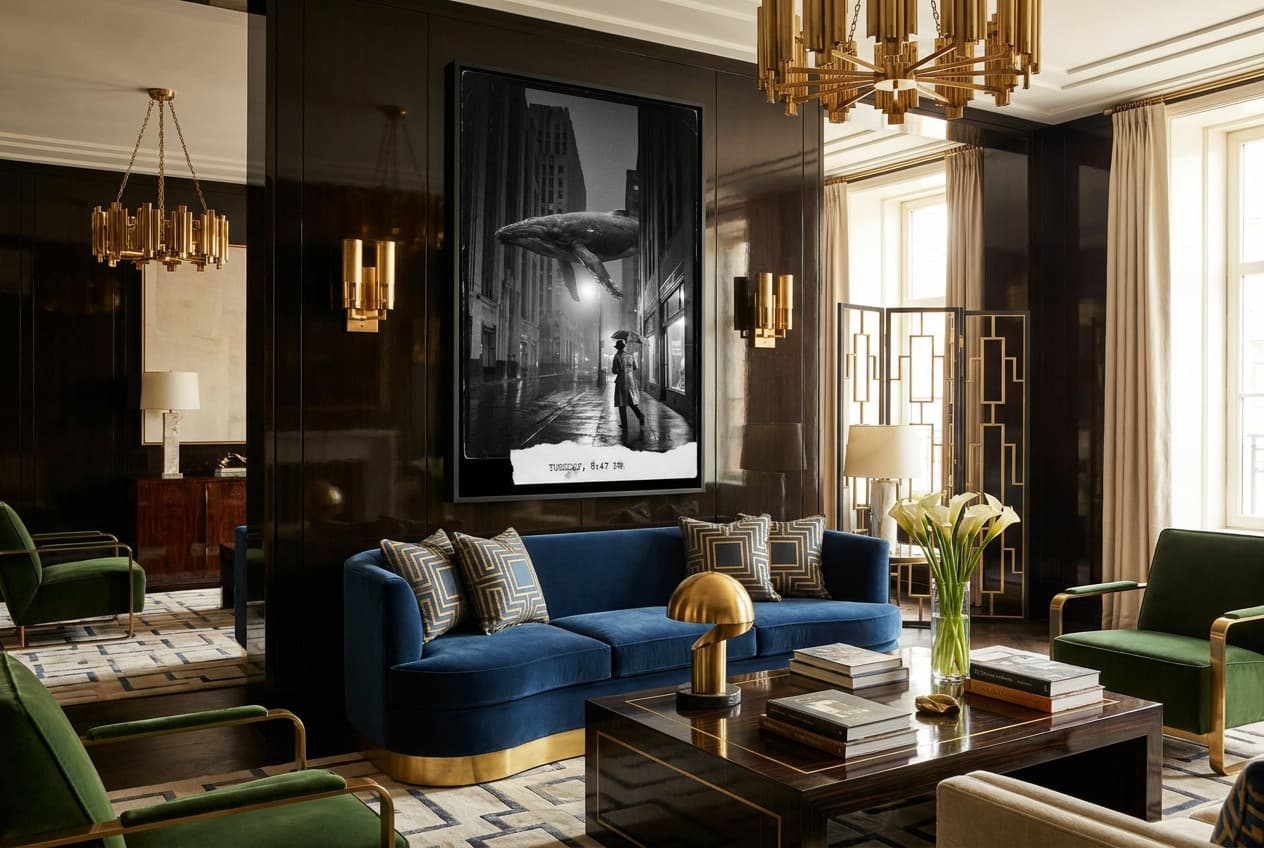
Hang the bottom edge of the artwork 15 to 20 cm above the top of the sofa back. That gap is close enough for sofa and art to read as one unit, and wide enough that nobody's head touches the frame. It is the most useful number in this guide, because hanging too high is the mistake people make far more often than hanging too low.
Start 15 to 20 cm above the backrest
Measure from the floor to the top of the backrest, add 15 to 20 cm, and that is where the bottom edge of your print goes. On a sofa with an 85 cm back, the art starts at 100 to 105 cm from the floor. For a pair or a trio, the bottom edges of all pieces sit on this same line, and the gap is the same for every piece.
If loose back cushions sit higher than the frame, measure to the top of the cushions as they normally sit. The art relates to what you see, not to the woodwork underneath.
Eye level, and why the two rules usually agree
Galleries hang art with its centre at roughly 145 cm from the floor, average standing eye level. People worry that the eye-level rule and the gap rule contradict each other above a sofa. With tall prints they rarely do: a 90 cm tall print whose bottom edge sits at 100 cm has its centre at 145 cm. The two rules land in the same place.
They only disagree with short compositions or very low sofas, and then the gap rule wins: a print hovering 40 cm above the backrest to reach "eye level" looks disconnected from everything beneath it. The same logic applies in the bedroom, where the headboard replaces the backrest; our guide to above bed decor ideas walks through that room with the same numbers.
Low-back sofas, sectionals and tall ceilings
A low modern sofa with a 70 cm back leaves a lot of wall above it. Keep the 15 to 20 cm gap anyway and fill the extra height with taller art: 60×90 cm prints rather than 50×75, or a two-row grid. The wall above the art can stay empty; the wall between sofa and art should not.
On a sectional, size and centre the art on the longest straight run, not the whole L-shape; the chaise does not need art above it. With ceilings above 2.7 m, resist hanging higher to "use the space": keep the art attached to the sofa and let the wall above breathe. Posters for living room walls in the two largest formats add height without climbing.
Seven above sofa wall decor layouts built from vertical prints
Each layout gives the total width it covers, the gap to use and the sofa width it suits, so you can pick one from the table above and order. All of them use portrait-format prints: the same sizes, hung in different numbers.
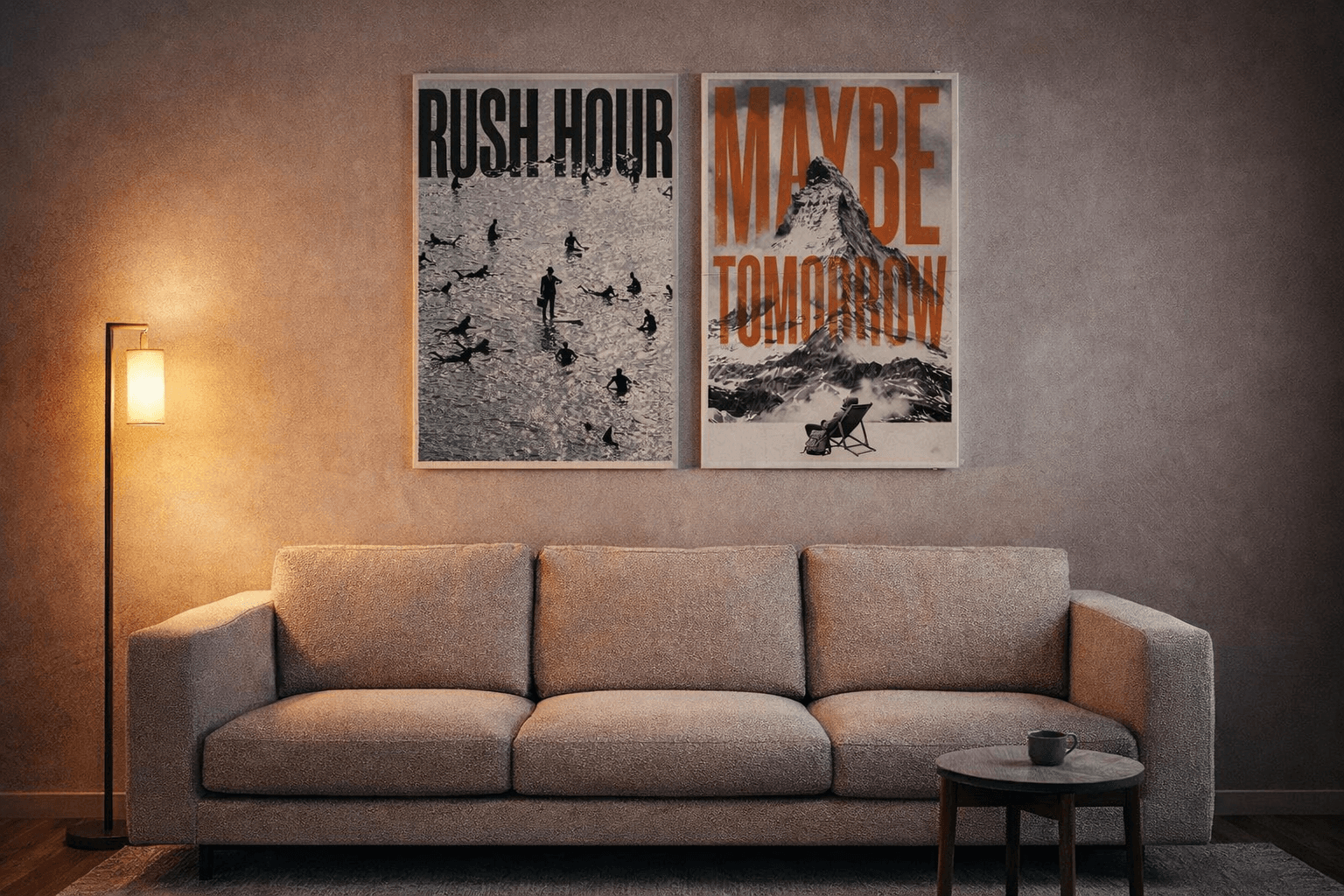
1. A pair of 60×90 cm prints above a three-seater
Two 60×90 cm prints with an 8 cm gap cover 128 cm, the sweet spot for a 180 to 200 cm sofa. Centre the pair on the sofa, bottom edges 15 to 20 cm above the backrest, and the wall is done. This is the layout we recommend most often because it is almost impossible to get wrong.
Choose two images that share a palette or a subject rather than two halves of one picture. A pair of posters 60x90 cm in the same frame colour, one busier and one calmer, has a left-to-right rhythm a split image never has. A canvas 60x90 cm pair hangs with no frame at all, which keeps the 8 cm gap looking clean.
2. A trio of 50×75 cm prints above a long sofa
Three 50×75 cm prints with 6 cm gaps cover 162 cm, which suits a 220 to 240 cm sofa. Keep the bottom edges on one line and the gaps identical; a trio forgives a lot, but not uneven spacing. Odd numbers feel resolved because the middle piece gives the eye a place to rest.
Give the trio a sequence: three landscapes from dawn to dusk, three abstracts in the same colours, or one bold image flanked by two quieter ones. For sectionals of 280 cm and more, scale up to three 60×90 cm prints, which cover 192 cm.
Odd numbers are the 3-5-7 rule of decorating in practice: three, five or seven pieces feel more natural than an even group because the eye settles on a middle one. A pair still works when both prints are large and the gap is tight, since the eye then reads them as one wide unit; the rule matters more as the pieces get smaller.
3. A pair of 50×75 cm prints above a loveseat
A 160 cm two-seater takes two posters 50x75 cm with a 7 to 8 cm gap, 107 to 108 cm in total. It is layout 1 one size down, so the same pairing advice applies. In a small living room this is often the best result, since a pair of 60×90 cm prints would overhang a loveseat's arms.
4. A grid of 30×45 cm prints
A grid is the most structured sofa wall there is, and it scales to any sofa by changing the column count. Three columns by two rows of 30×45 cm prints with 6 cm gaps measure 102 cm wide by 96 cm tall, right for a 150 to 160 cm sofa. Four columns by two rows measure 138 cm wide, right for a 200 cm sofa.
Grids need discipline: identical frames, identical gaps, a spirit level. They reward a single theme, such as six black-and-white photographs or six abstracts from one series. Hang the bottom row on your 15 to 20 cm line first, then build upwards.
5. A row of four 30×45 cm prints under a window or low ceiling
Sometimes the wall above the sofa is short: a window sits just above the backrest, or the ceiling slopes. A single row of four 30×45 cm prints with 6 cm gaps covers 138 cm wide but only 45 cm tall, so it slips into a band of wall nothing else would fit. It suits a 200 cm sofa and echoes the sofa's own long, low line.
6. One 60×90 cm print off-centre, balanced by a floor lamp
One 60×90 cm print centred over a 200 cm sofa covers barely 30 per cent of its width, and it looks lost. Hang the same print off-centre instead, above one end of the sofa, and put a tall floor lamp or a large plant at the other end. The lamp and the print now form a pair, and the composition covers the full width the 2/3 rule asks for.
This is the layout for one strong image rather than a matched set. Line the print's outer edge up with the sofa arm below it, keep the 15 to 20 cm gap, and let the lamp reach roughly the top of the print.
7. A salon-hang gallery wall in mixed sizes
A salon hang mixes sizes and lets the group grow over time. Start with one 50×75 cm anchor, slightly off-centre, then build outwards with 30×45 and 20×30 cm pieces until the cluster covers two-thirds of the sofa width. Keep the gaps at 5 to 8 cm even though the sizes vary, and the lowest edge on the 15 to 20 cm line.
Plan it on the floor first, or with paper templates taped to the wall. Our gallery wall guide covers the layouts in detail, including how to keep a loose arrangement from looking random.
Choosing the style and colour of art above your couch
Once size and height are settled, the art itself is a question of contrast. The sofa is the largest coloured object in the room, so the art above it should echo its undertone or deliberately oppose it. Matching it exactly rarely works: a grey print above a grey sofa disappears.
Match the sofa's undertone, not its colour
Every sofa fabric leans warm or cool. Camel, rust and cream are warm; charcoal, navy and sage are cool. Pick art that shares the undertone and the wall feels pulled together even when the actual colours differ. A terracotta abstract above a caramel leather sofa works; the same print above a steel-blue velvet sofa fights it.
The exception is black and white, which sits comfortably above any sofa colour and, in a pair or a grid, looks deliberate rather than cautious.
Abstract and minimalist art for a calm wall
Abstract art is the natural choice above a sofa because it carries colour without demanding attention from across the room. Abstract posters in a limited palette, two or three colours plus a neutral, are easy to pair and easy to live with. For a frameless look, abstract canvas prints in a 60×90 cm pair give a modern living room its focal point without a single frame edge.
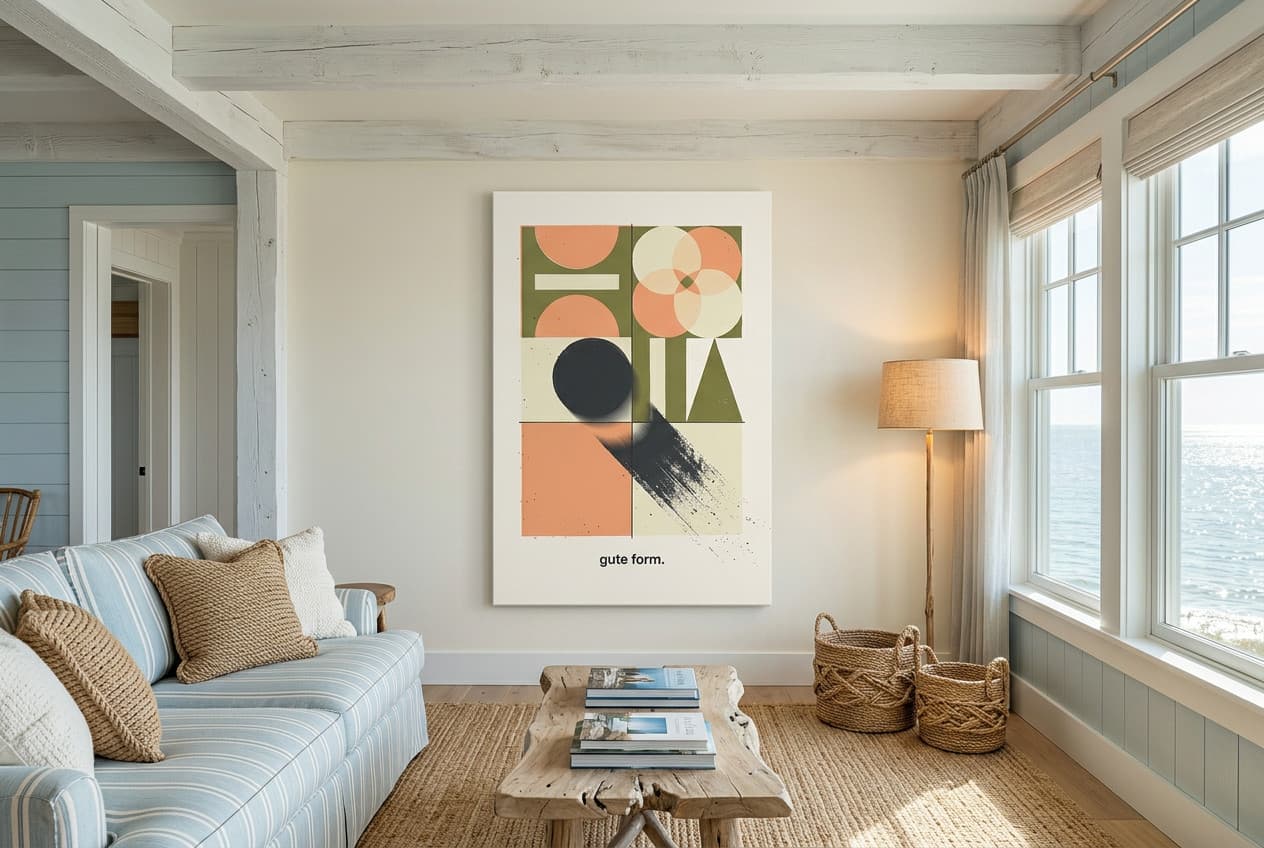
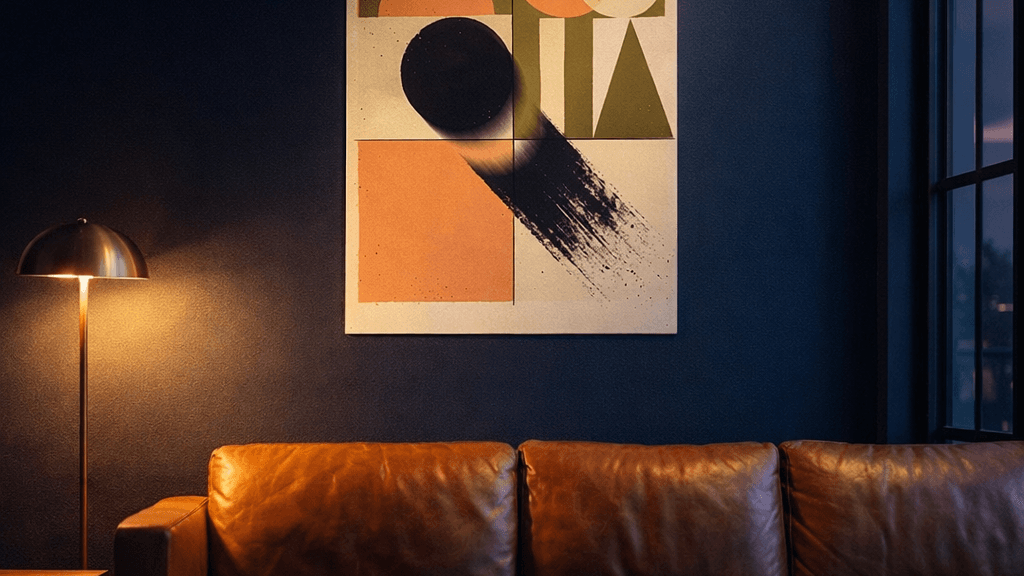
A Bauhaus-inspired composition like this one, in olive, peach and cream with a single black circle, is a good example of an abstract that holds a wall on its own and still works as one half of a pair. Minimalist posters do the same job with even less: a single line, one shape, a lot of paper. They suit grids especially well, where six quiet images add up to one confident statement.
Landscapes and black-and-white photography for depth
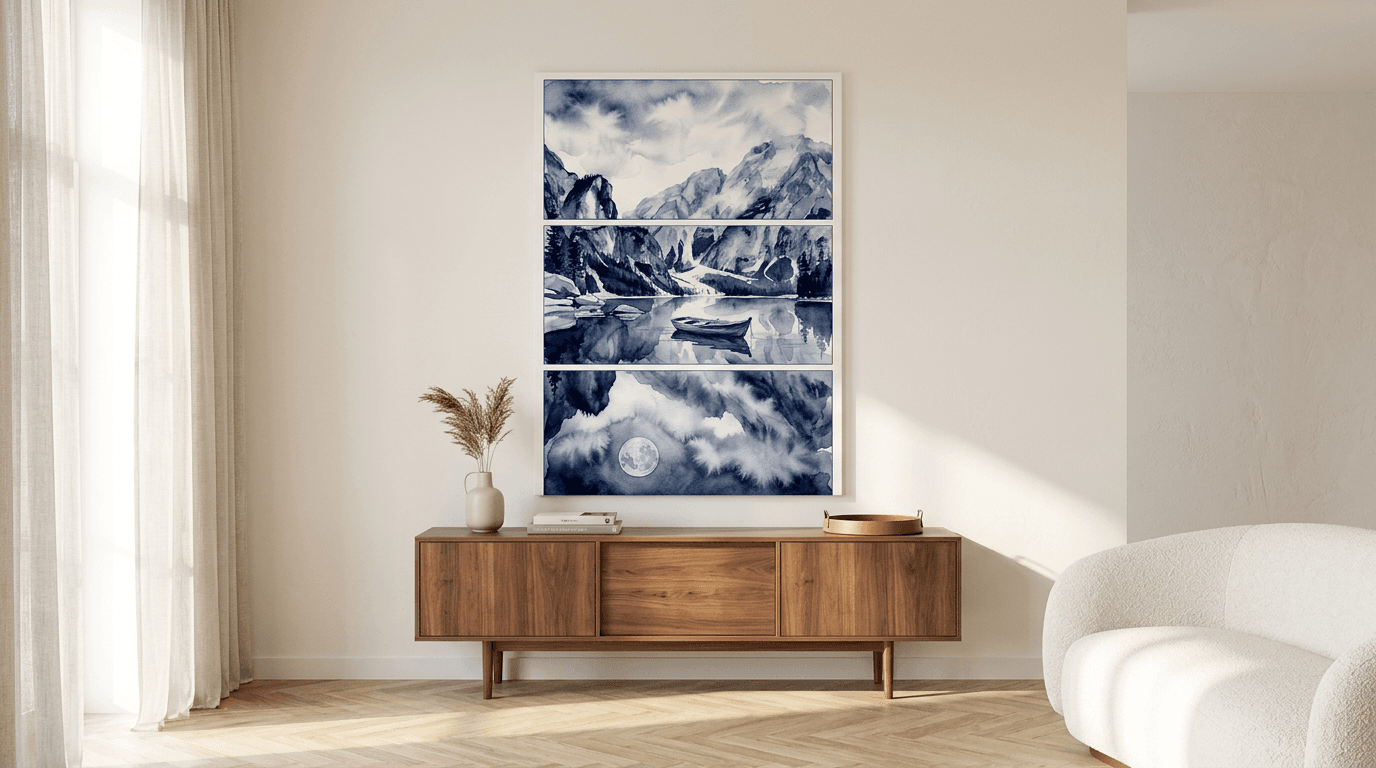
Landscapes give a flat wall a horizon, which is why they feel so natural above a sofa. Three 50×75 cm landscapes in a trio read like three windows. Canvas suits them particularly well because the matte, frameless surface makes the image feel like a view rather than a picture; browse landscape canvases that let you escape into art and look for a consistent light across the set.
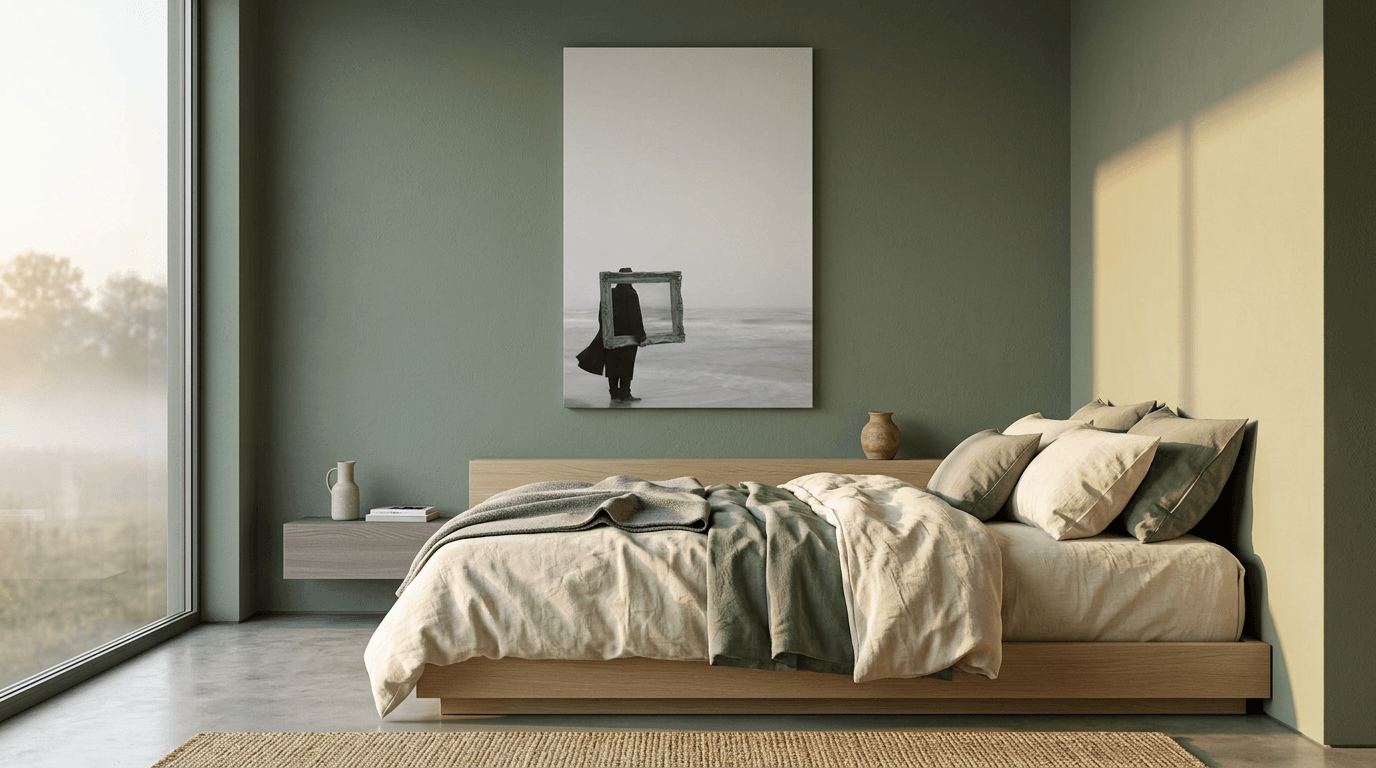
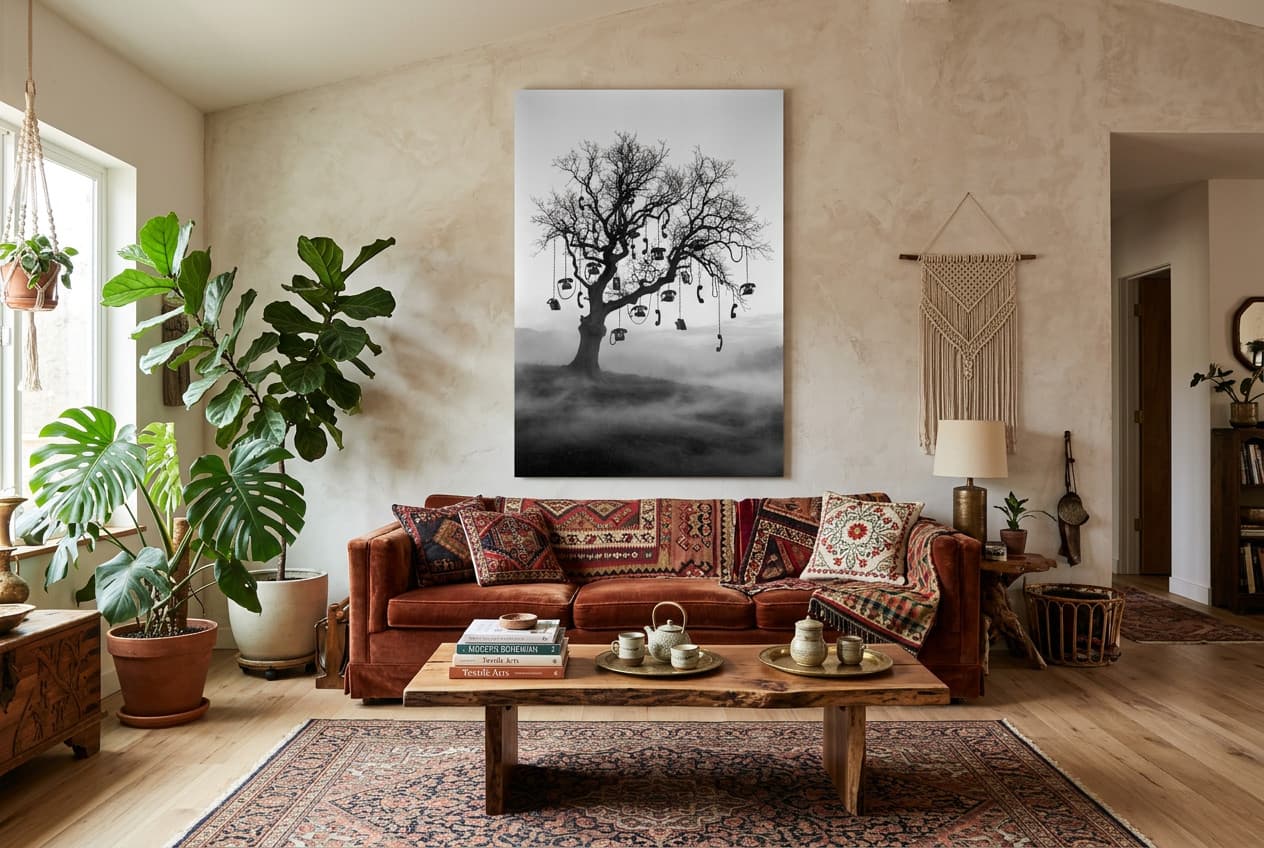
Black and white photography is the other reliable answer, and the most forgiving when it comes to colour. A monochrome image like this misty oak, hung with old telephones, brings the surreal note a living room can take, and it will not argue with any sofa fabric you choose later.
Poster or canvas above the sofa?
Both work; the choice depends on the layout. Canvas suits pairs and trios of large prints that should float on the wall. Framed posters suit grids, rows and gallery walls, where the frame becomes part of the pattern.
Canvas: frameless and ready to hang
A stretched canvas arrives on its wooden frame, ready to hang, so there is nothing to frame and no glass to reflect the window opposite. That absence of reflection matters above a sofa, which usually faces the brightest wall in the room. Canvas prints for living room walls in 50×75 or 60×90 cm are also light enough to hang in minutes, which makes a pair or a trio a half-hour job.
Framed posters: black or white wood for pairs and grids
A poster in a slim black or white wood frame gives you a crisp edge, and repeated edges are what make grids and rows work. Black frames suit darker walls and cool-toned sofas; white frames lift pale walls and warm fabrics. For living room posters hung as a 3×2 or 4×2 grid, choose one frame colour and stick to it; the frame adds a little width on each side, so run the arithmetic with the outer frame measurement.
Mixing canvas and posters on one wall
Mixing canvas and framed posters on the same sofa wall is harder, because the eye registers the frames as the pattern and the canvases as gaps in it. If you want both, keep them in separate groups: a canvas pair above the sofa, framed posters on the adjacent wall. For the rest of the room, our living room decorating guide covers how the sofa wall fits with everything else.
Five mistakes that make art above a sofa look wrong
Most sofa walls that feel off share one of five faults, each with a quick fix.
Too small. One 30×45 cm print above a 200 cm sofa covers 15 per cent of its width. Fix: go to a pair of 60×90 cm prints, or a grid that reaches 130 cm.
Too high. A 40 cm gap between the backrest and the art cuts the two apart. Fix: lower the art until the gap is 15 to 20 cm, even if that puts the centre below "eye level".
Centred on the wall instead of the sofa. When the sofa sits off-centre on a wall, art centred on the wall looks like it is sliding away. Fix: centre on the sofa, always.
Uneven gaps. A trio with 5 cm on one side and 9 cm on the other reads as a mistake. Fix: cut a strip of card to the gap width and use it as a spacer.
Ignoring the window and ceiling line. Art that stops 3 cm below a window frame or a cornice looks pinched. Fix: leave a clear 15 cm to the next line, or switch to a lower, longer layout such as a single row.
Your above-sofa checklist
Measure the sofa from arm to arm and multiply by two-thirds: that is your target art width. Pick the layout from the table that reaches it, using 5 to 8 cm gaps. Mark a line 15 to 20 cm above the backrest and hang every bottom edge on it. Choose art in the sofa's undertone, or go black and white. Decide on canvas or framed posters by layout, not by habit.
Follow those five steps and the above sofa wall decor question answers itself: the biggest blank in the room becomes the thing people look at when they sit down.