Cat room ideas: 12 ways to design a space you'll both love
A cat room needs climbing routes, hiding spots and a litter solution, but it doesn't have to look like a pet store aisle. Here are twelve cat room ideas that keep your cat busy and your home beautiful.
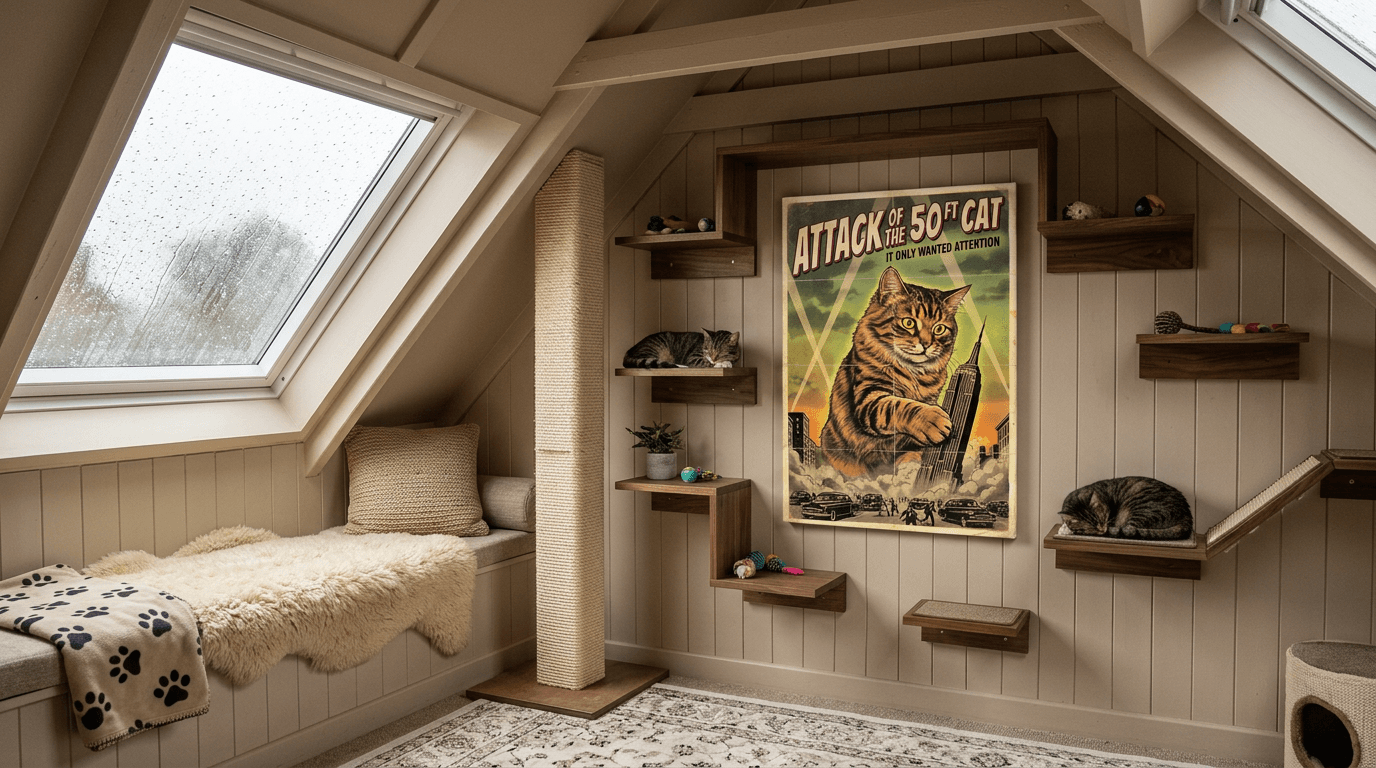
The best cat room ideas solve two problems at once. Your cat needs territory: routes to climb, surfaces to scratch, warm spots to sleep and a window to supervise. You need the room to still feel like part of your home, not a beige annex of carpet-covered towers.
Most guides handle the first problem thoroughly and abandon the second. So this list does both: the functional essentials first, honestly and briefly, then the part almost nobody covers. The palette, the materials, the feeding corner, the floor, the storage, and above all the walls that turn "the cat's room" into a room you genuinely like walking into. Whether you have a spare bedroom, a landing or two square meters of hallway, every idea below scales.
1. Cover the cat room essentials: climbing, scratching, sleeping
Every cat room needs three things before any decorating happens: vertical territory, legal scratching surfaces and a choice of sleeping spots. Get these right and your cat will actually use the room. Skip them and the prettiest space in the house will sit empty.
Vertical territory matters most. Wall-mounted shelves arranged as a climbing route, a sturdy floor-to-ceiling cat tree, or a cleared bookcase top all work. What counts is that your cat can get high and survey the room. Space the shelves 30 to 40 cm apart vertically and stagger them sideways so each jump is a short diagonal, not a vertical leap, and give the route a destination: a wide top shelf with a cushion, not a dead end.
Add at least one scratching post or flat cardboard scratcher near the entrance, because cats scratch where traffic happens, not where it's convenient for you. A post needs to be taller than your cat at full stretch (around 80 cm for an adult) and heavy enough not to wobble, or it will be ignored in favour of your sofa.
For sleep, offer contrast: one open perch by the window for sunbathing and bird television, and one enclosed hideaway, a covered bed or a basket on a low shelf, for retreat. Cats choose differently depending on mood, temperature and how trustworthy the vacuum cleaner has been lately.
2. Hide the litter box in plain sight
The litter box is the reason many cat rooms exist, and it's the first thing to solve, because everything else in the room is easier to style than an open tray. The modern answer is concealment furniture: a bench, cabinet or side table with an interior compartment and a cat-sized entrance, so the box disappears into something you'd own anyway.
Two rules keep it working. Ventilation first: a concealed box needs airflow and more frequent scooping, not less, or your cat will boycott it. Location second: keep litter well away from food and water, ideally on the opposite side of the room. The common rule of thumb of one box per cat plus one spare still applies, even in a dedicated cat room.
If you build or buy a litter cabinet, make the interior washable (a plastic liner or a sheet of vinyl flooring cut to size) and the entrance at least 20 cm wide. A litter mat inside the cabinet, in front of the tray, catches most of the scatter before it reaches your floor.
3. Choose one palette, and materials that survive claws
Here is where design guides usually go quiet, and where a cat room either becomes a real room or a storage area with toys. Pick one restrained palette, three colours and no more, and buy everything within it: the cat tree, the bedding, the storage baskets, the rug. A sisal tree in natural tones against a warm white wall reads as intentional. The same tree in random beige next to a blue bed and a red tunnel reads as clutter.
Materials do the rest. Choose washable throws, tight-weave fabrics that don't pull into loops under claws, and wood over laminate: wood scratches into patina, laminate scratches into damage. Microfibre and tightly woven cotton canvas are the two upholstery fabrics that hold up best; bouclé, velvet and loose linen are the three that don't.
If you want a shortcut to a palette that always works with natural materials, the restraint principles from japandi interior design translate almost perfectly to cat spaces: few colours, honest materials, empty space left on purpose.
4. Treat the walls as a gallery, not a bulletin board
Walls are where cat rooms usually collapse into kitsch: a "Crazy Cat Lady" plaque, a calendar, a sagging cork board. Yet the walls are the one surface your cat can't destroy and the biggest design opportunity in the room. Treat them the way you'd treat any other room: two or three well-chosen pieces of real art, properly spaced, hung at eye level.
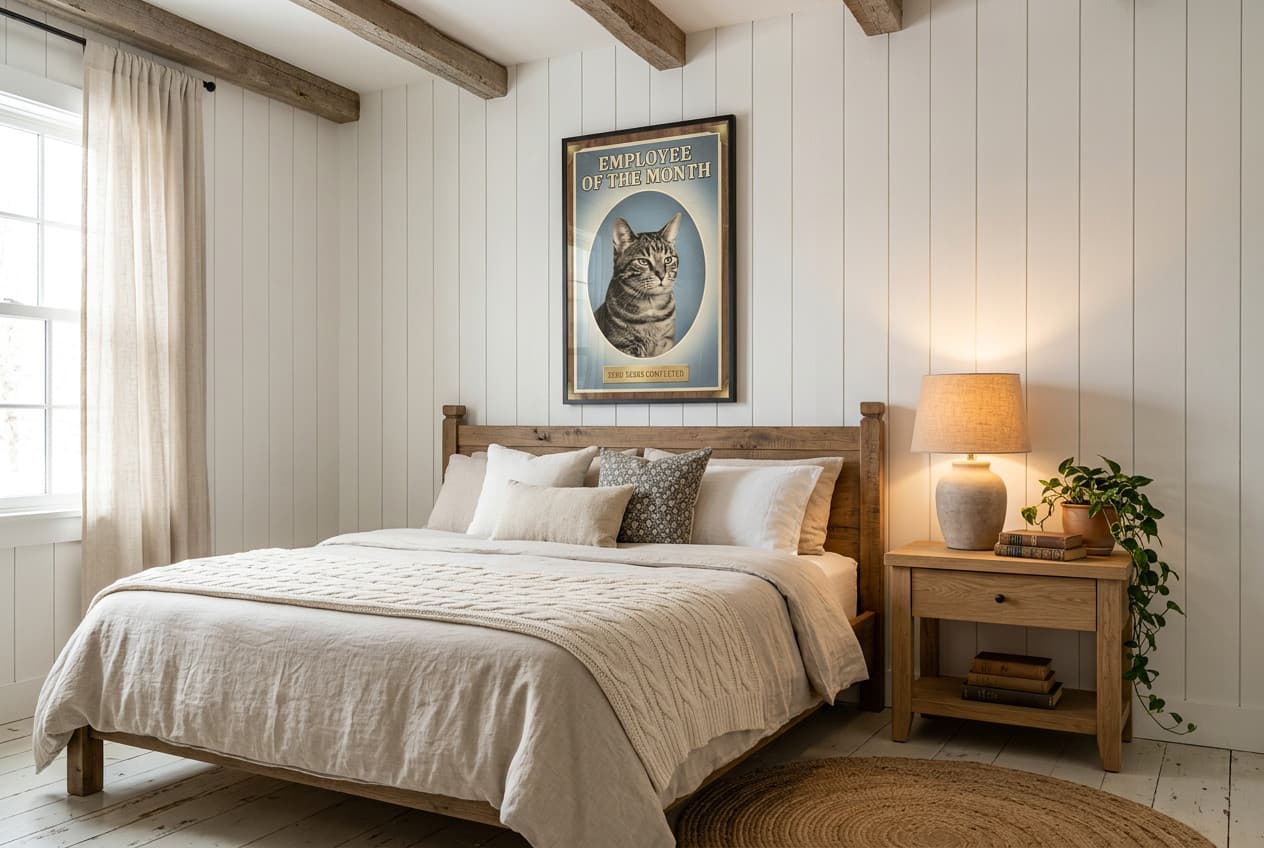
Cat-themed art doesn't have to mean cartoon kittens. Graphic, painterly and vintage-style cat posters can hold a wall the way any strong print does; the subject just happens to share the room with its inspiration. Hang them between the cat shelves rather than behind them, so climbing routes and art read as one composed wall instead of competing for space.
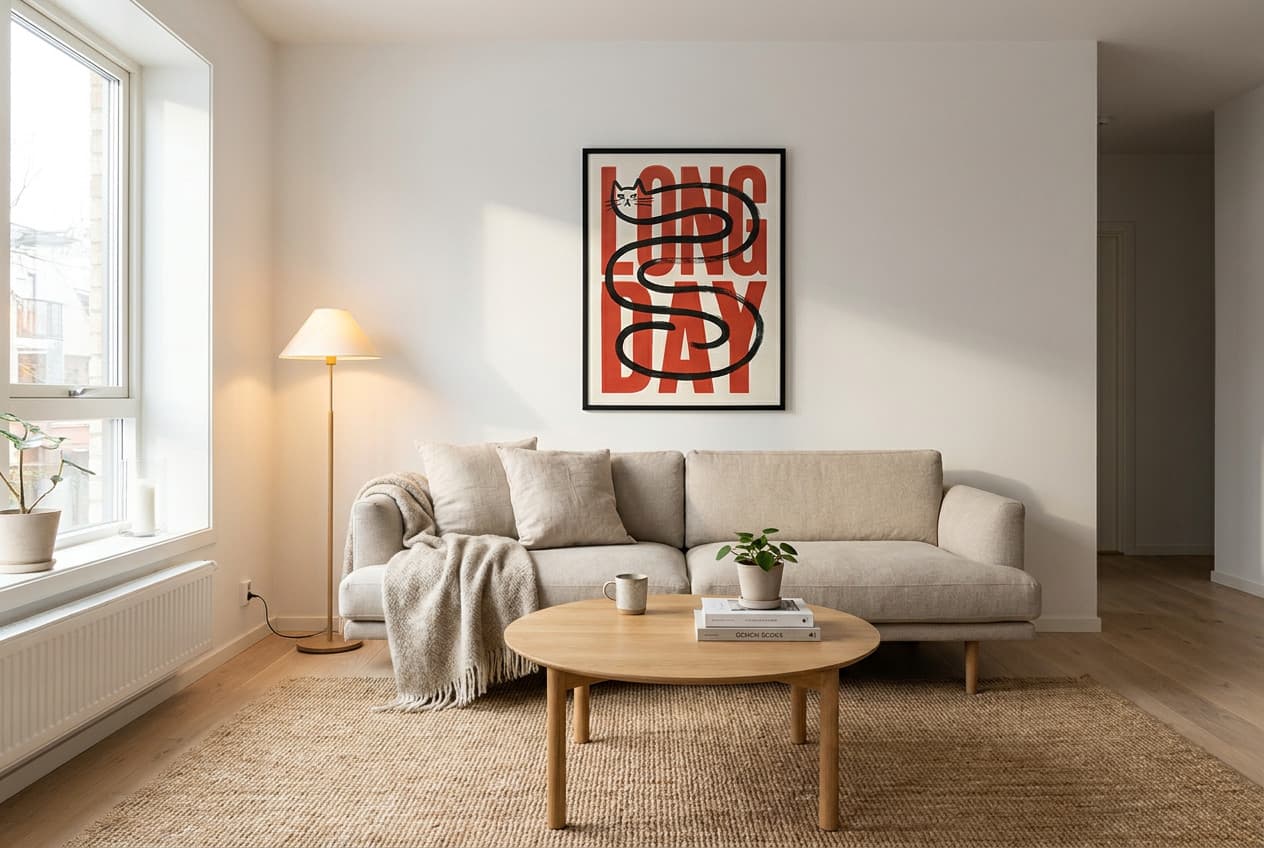
A little humour survives the gallery treatment fine, as long as the execution is strong. A piece like this one earns its place on wit and colour, not on novelty:
5. Make your own cat the centerpiece with a custom portrait
If you hang only one piece in the room, make it a portrait of the actual cat who lives there. Nothing generic competes with it: it anchors the whole space around its resident, and every visitor asks about it. This is the single best design move a cat room can make, and it's also the least effort.
Effigiz's custom pet portrait wizard does it in a few minutes: upload a clear photo of your cat, pick an art style, from classical portrait to bold modern looks, and choose poster or canvas. You can add your cat's name to the piece, and a 50×75 cm or 60×90 cm format is large enough to carry the main wall on its own.
It also solves next year's gift problem in passing. A portrait of someone's own cat is the rare present that gets framed instead of forgotten, which is why it leads our guide to gifts for cat lovers.
6. Add depth with canvas and framed prints
Once the centerpiece is set, vary the physical formats around it. A wall of identical paper prints reads flat, while mixed formats read collected. Stretched canvas brings texture and sits off the wall with no glare, which suits larger statement pieces; posters suit tighter groupings and easy swapping when you want the room to evolve.
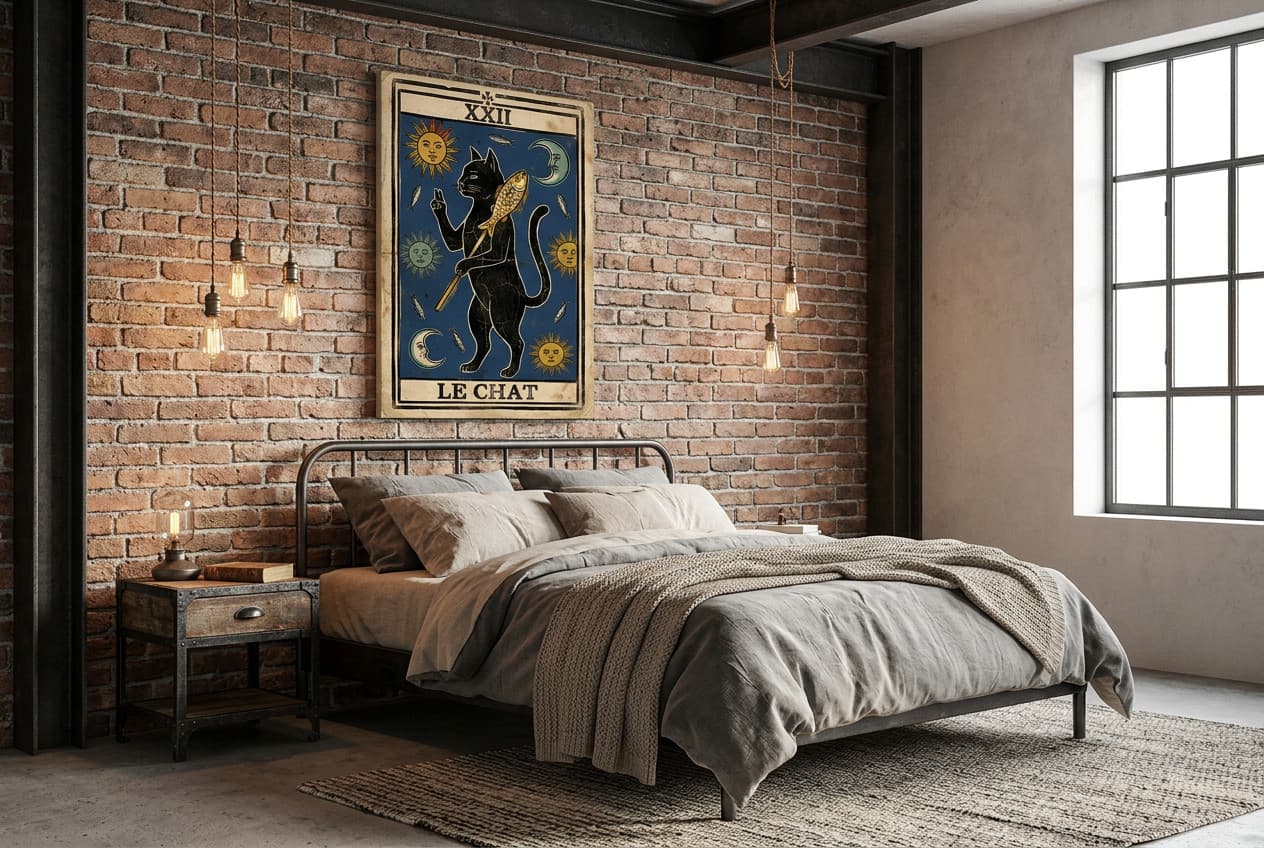
A practical mix for one wall: a 50×75 cm canvas as the anchor, flanked by two 30×45 cm posters, with a small 20×30 cm print tucked near the cat shelves as a discovery piece. Framing the posters in slim black or white wood sharpens the gallery effect and protects the paper from curious paws. Browse cat canvas prints alongside the poster range and pick both formats from the same palette so the wall stays coherent.
7. Pick the right room (it's rarely the spare bedroom)
Location decides how much the room gets used, so settle it before you buy a single shelf. The obvious candidate, the spare bedroom at the end of the corridor, is often the worst one: cats are social supervisors, and a room far from where the household actually lives becomes a storage room with a cat tree in it. The best cat rooms borrow space near the action: a wide landing, the void under the stairs, a walk-in closet off the living room, a converted office corner, an attic with a dormer window.
Two tests tell you whether a spot will work. Sightlines: from the top shelf, can your cat watch doors and people? Warmth: is there a sunny patch for at least part of the day? A north-facing box room fails both tests no matter how well you furnish it.
Under-stairs and closet conversions deserve a proper finish rather than a cave. Paint the interior a deliberate colour from your palette, run shelves along the sloping wall as the climbing route, and fit a low-voltage LED strip above the top shelf so the space reads as a built-in alcove rather than a cupboard with the door left open.
8. Give the window a job: perch, catio, or both
A window is the single most valuable fixture a cat room can have, and most rooms waste it. At minimum, build a proper perch: a deep sill extension or a wall-mounted shelf at sill height, 30 cm deep, with a washable cushion. Add a bird feeder outside, a few metres away, and the perch becomes the most-used square metre in the house.
If you can go further, a catio, a screened outdoor enclosure fitted to the window, gives an indoor cat fresh air, sun and insects to stalk without any of the outdoor risks. Window-box catios start at the size of an air-conditioning unit and need no planning permission; balcony and garden versions scale up from there. Use powder-coated steel mesh rather than chicken wire, which cats can bend, and give the catio its own climbing shelves so it isn't just a box.
Treat the window wall as the room's focal point and keep art off it. The view and the daylight do the work there; your prints belong on the wall your cat faces from the perch, where they're lit, not backlit.
9. Give the feeding corner dining-room manners
Food and water are the second thing cats care about and the thing owners style last, which is why most cat rooms have a pair of plastic bowls on a tea towel. Raise the bowls 8 to 10 cm on a stand (easier on the neck for adult cats), choose ceramic or stainless steel in a colour from your palette, and set them on a washable mat with a border that catches splashes.
Place water away from food, by at least a metre. Cats instinctively distrust water that sits next to a kill, which is why many drink more from a fountain across the room than from the bowl beside their dinner. A small ceramic fountain also solves the stagnant-water problem and, in the right colour, looks like a deliberate object rather than a gadget.
Keep this corner clear of the litter area and the main climbing route. A feeding station tucked beside a cabinet, under a small print, reads like a dining nook; the same bowls in the middle of the floor read like a kennel.
10. Choose flooring and rugs that forgive
Cats are gentler on floors than dogs, but a cat room still has to survive litter scatter, hairballs and the occasional sprint-and-skid. Hard floors win: sealed wood, laminate or luxury vinyl clean in seconds and don't trap odours. Wall-to-wall carpet is the one thing to avoid, because scatter works its way into the pile and a single accident is permanent.
Rugs bring the softness back, with three rules. Flat-weave or low-pile only (loops snag claws). Washable, which today means cotton flat-weaves and the newer machine-washable synthetics. And sized to the zone rather than the room: a 120×180 cm rug under the climbing tree and bed anchors the "cat zone" visually, the way a rug under a sofa defines a seating area.
Pick the rug in your palette's darkest tone. It hides hair between vacuums and gives the room a visual base, so the pale walls, the wood and the art above it all read lighter by contrast.
11. Make storage part of the decor
Cat rooms accumulate stuff: the carrier, the spare litter, the toy mice, the brush, the cardboard scratcher you're not ready to throw away. The design-room answer is closed storage that matches the furniture you already chose: a low cabinet in the same wood as the shelves, lidded baskets in the palette, a bench with a lift-up seat that doubles as the window perch.
One rule keeps the room from drifting back into pet-store mode: nothing branded stays visible. Decant food into a sealed container, keep the toys in a single basket, and store the carrier out of sight (or make it part of the furniture by leaving it open with a cushion inside, which also removes the vet-day panic). Wall hooks at human height for the harness and the brush turn a utility into a tidy detail.
The reward for this discipline is the walls. With the floor clear and the storage closed, the eye goes straight to the climbing route and the art, which is the whole point of the room.
12. No spare room? Build a cat corner instead
A full cat room is a luxury of floor plans; a cat corner delivers most of the benefit in two square meters. The formula compresses everything above: one vertical element (a tall tree or three staggered wall shelves), one enclosed bed below it, a scratcher at the base, the bowls on a mat to one side, and the litter solution concealed in a nearby cabinet.
The design layer matters even more in a shared space, because the corner has to harmonise with the room around it. Match the shelf wood to your existing furniture, keep the textiles inside your room's palette, and hang one or two prints directly above the corner to mark it as intentional. In a family room or hallway, playful animal posters tie a cat corner into the wider space without a single word of signage.
On a budget, this is also where to start, in this order: a scratcher and one shelf route first (under 100 euros), then the bed and the rug, then the art, then the furniture upgrades. A corner done deliberately beats a full room done carelessly, and you can always expand it later. The same corner logic, adapted to a bigger animal, runs through our dog room ideas.
A room you built for both of you
Good cat room ideas don't force a choice between your cat's needs and your home's look. Start with the essentials (climbing, scratching, sleeping, litter), pick the right spot and give the window a job, then commit to one palette, forgiving materials, closed storage and walls treated as a real gallery, with your own cat's portrait at the centre of it. The result is a space your cat genuinely uses and a room you leave the door open to on purpose. Start small if you need to: a corner done deliberately beats a full room done carelessly, and both are built one good decision at a time.
Cat room FAQ
What is the 3-3-3 rule for cats?
The 3-3-3 rule describes how newly adopted cats typically adjust: about three days to decompress, three weeks to learn routines, and three months to feel fully at home. A ready cat room helps enormously during this window. A quiet space with hiding spots, food, litter and elevated perches gives a new cat a safe base to adjust from at their own pace.
Are cats happier indoors or outdoors?
Most veterinarians recommend indoor life for safety: indoor cats avoid traffic, predators, fights and disease. Happiness indoors depends entirely on enrichment, which is exactly what a well-designed cat room provides. Climbing height, window views, a catio if you can manage one, scratching outlets and play replace the stimulation the outdoors would have offered, without the risks.
How big does a cat room need to be?
Smaller than you think. A cat uses vertical space more than floor space, so a 4 m² alcove with a full-height climbing route offers more territory than a 15 m² bedroom with a cat tree in the corner. What matters is height, a window, and a layout that separates sleeping, eating and litter zones.